Hip and Knee Replacement Outcomes Birmingham
Mr Shakir Hussain's surgical results, drawn from the National Joint Registry (NJR). The NJR is the world's largest joint replacement registry, recording every hip and knee replacement performed in the UK since 2003, and allows patients to compare any consultant orthopaedic surgeon's revision rate against the national average.
When you choose a hip or knee surgeon you should expect to see their results. The figures on this page come from the National Joint Registry, which records every joint replacement performed in the UK since 2003 and allows direct comparison of revision rates against the national average.
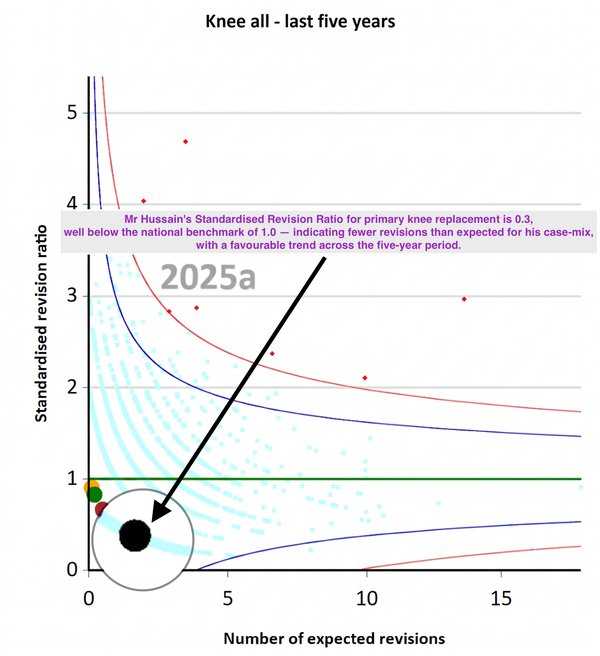
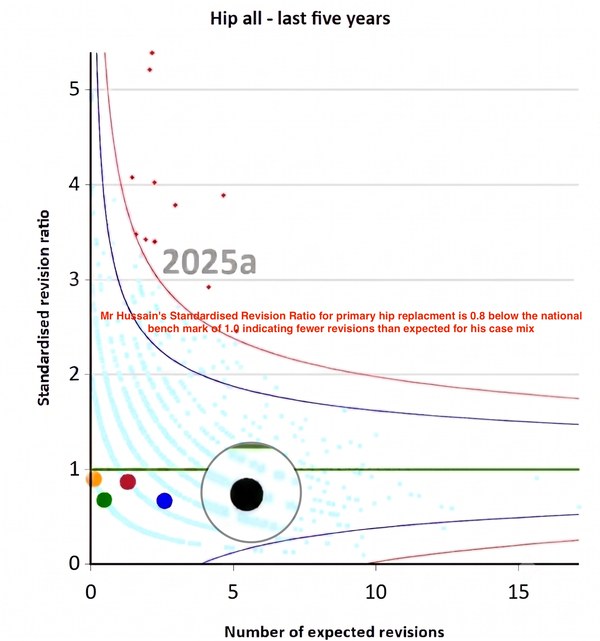
The funnel plots below are drawn from Mr Hussain's NJR surgeon profile (GMC 6135851). Each dot on a funnel plot represents one UK surgeon. Surgeons whose position falls below the lower control limit have a revision rate statistically lower than the national average.
Knee Replacement Revision Rate: Mr Hussain's NJR Results
As with his hip practice, Mr Hussain's knee replacement work is based primarily at the Royal Orthopaedic Hospital Birmingham, a tertiary centre where complex deformity correction, high-risk patients, and referrals from other consultants are concentrated. The NJR's Standardised Revision Ratio adjusts for this, comparing each surgeon's actual revisions only against what would be expected for their specific case-mix.
Mr Hussain's SRR for primary knee replacement over the last five years is 0.3, meaning his primary knee replacements require further surgery 70% less often than predicted for the complexity of his patients, with a favourable trend across the full five-year reporting period. An SRR this far below the national benchmark of 1.0 places him among the top-performing knee replacement surgeons in the UK.
Hip Replacement Revision Rate: Mr Hussain's NJR Results
Mr Hussain's primary practice is at the Royal Orthopaedic Hospital Birmingham, one of the UK's leading tertiary orthopaedic centres. Tertiary centres concentrate the most challenging cases: patients with severe deformity, failed previous surgery, complex medical histories, and high-risk referrals from other consultants across the country. Because of this, NJR methodology adjusts each surgeon's expected revision count to reflect their actual case-mix, producing a Standardised Revision Ratio (SRR). An SRR of 1.0 is the national benchmark.
Mr Hussain's SRR for primary hip replacement over the last five years is 0.8, below the national benchmark of 1.0, meaning his primary hip replacements require further surgery around 20% less often than predicted for the complexity of his patients. His position on the funnel plot below sits below the national benchmark line, reflecting fewer revisions than expected for his case-mix, achieved despite operating on some of the most demanding cases in the country.
How to read your NJR results
What is the National Joint Registry (NJR)?
The National Joint Registry of England, Wales, Northern Ireland, the Isle of Man and the States of Guernsey is the world's largest joint replacement registry. It records every primary and revision hip, knee, shoulder, elbow and ankle replacement performed in the UK since 2003, allowing patients to compare their surgeon's revision rates and patient-reported outcomes against the national average.
How can I check my surgeon's NJR results?
Every NJR-registered surgeon has a public profile at surgeonprofile.njrcentre.org.uk searchable by GMC number. The profile shows the number of primary and revision procedures performed, revision rates compared to the national average, and patient-reported outcome scores. Mr Hussain's NJR surgeon profile (GMC 6135851) is here.
What is a hip or knee replacement revision rate?
The revision rate is the percentage of primary joint replacements that subsequently need further surgery to repair, replace or remove the implant. Lower is better. Revision can be needed for many reasons including infection, dislocation, loosening, fracture around the implant, or wear of the bearing surfaces. NJR national averages sit around 1.6 percent for hip replacements and 2 percent for knee replacements over a ten-year follow-up period.
What are patient-reported outcome measures (PROMs)?
PROMs are standardised questionnaires completed by patients before and after surgery that measure pain, function and quality of life. For hip and knee replacement the NJR uses the Oxford Hip Score and Oxford Knee Score, the EQ-5D index, and a single satisfaction question. The PROMs improvement score reflects how much each patient improved compared to their pre-operative baseline.
Why does case mix matter when comparing surgeons?
Surgeons who accept high-risk and complex referrals from colleagues tend to operate on patients who are older, more frail, have severe deformity, or have failed previous surgery. These cases carry a higher baseline risk of revision and complication than routine first-time hip or knee replacement. A specialist with strong results despite a heavy complex caseload is generally a stronger marker of skill than a surgeon with the same revision rate from straightforward cases alone.
Want more depth? You can view Mr Hussain's full public surgeon profile directly at surgeonprofile.njrcentre.org.uk (GMC 6135851).
Ready to Discuss Your Hip or Knee Replacement?
Mr Hussain sees patients privately at the Royal Orthopaedic Hospital, Priory Hospital Edgbaston, and Harborne Hospital. Consultations are available for self-pay and all major insurers.