Hip Resurfacing
A bone-conserving alternative to total hip replacement for active patients, preserving your natural anatomy, enabling return to high-impact activities, and now available to both men and women with the latest ceramic-on-ceramic implant technology.
Medically reviewed by Mr Shakir Hussain, MBBS MRCS FRCSEd (Tr & Orth), Consultant Orthopaedic Surgeon · Last reviewed: June 2026 · Next review due: June 2029
In Short
Hip resurfacing is a bone-conserving alternative to total hip replacement: instead of removing the femoral head, it is reshaped and capped with a smooth metal or ceramic surface, and the socket is fitted with a matching shell. It suits active patients with good bone quality who want to return to demanding activity, with a lower dislocation risk and a more straightforward future revision than a conventional replacement. The operation takes around 1 to 1.5 hours, most patients go home the same day or after one night, and most return to high-impact sport by around six months. Mr Shakir Hussain performs hip resurfacing privately in Birmingham as a fixed package of £12,250 with the Adept implant or £13,450 with a ceramic implant.
Also known as: hip resurfacing arthroplasty, ceramic-on-ceramic hip resurfacing, bone-preserving hip replacement. For the full clinical guide, see what hip resurfacing involves on Mr Hussain's dedicated resurfacing site. If resurfacing is not suitable for you, see the hip replacement page.
On This Page
Mr Hussain now has a dedicated hip resurfacing website with in-depth information, patient stories, and the latest on ceramic-on-ceramic hip resurfacing. Visit hipresurfacing.uk for everything on this procedure.
Visit hipresurfacing.uk →What is Hip Resurfacing?
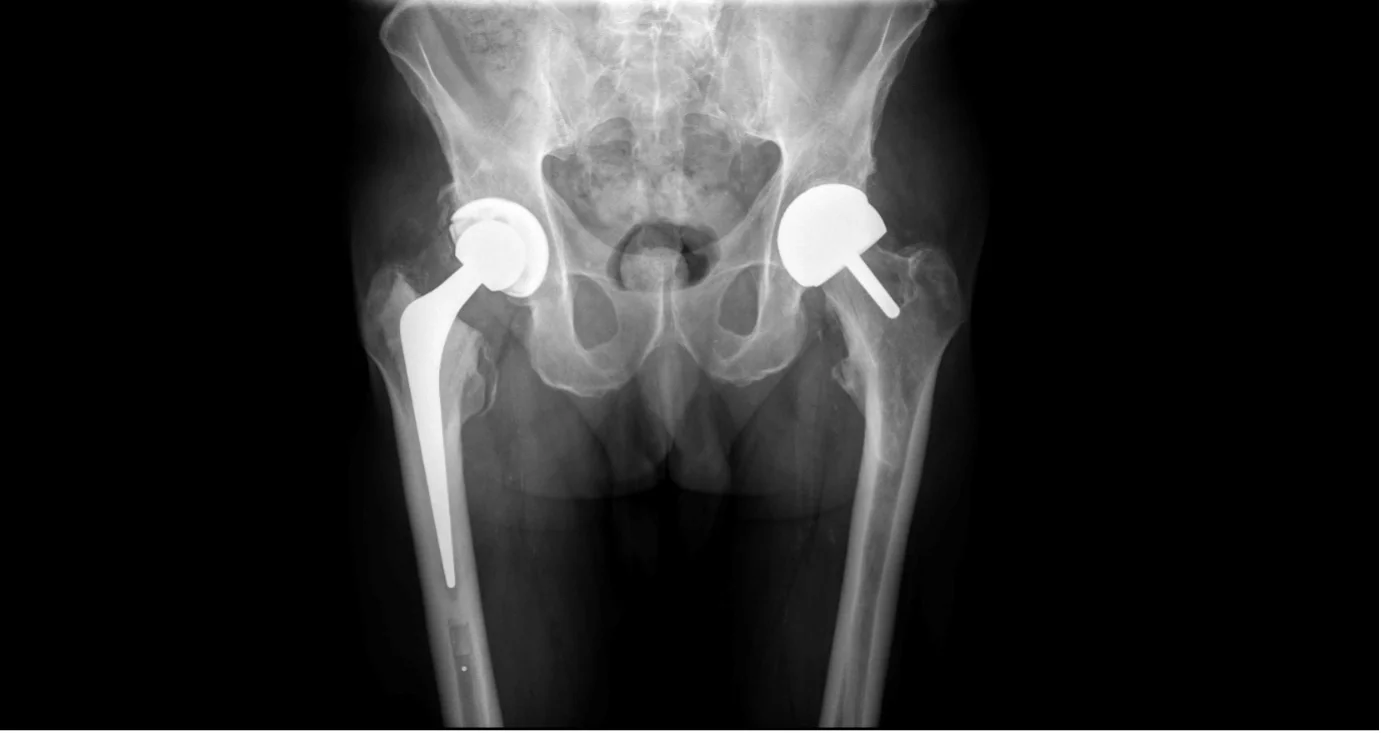
Hip resurfacing is a surgical procedure that treats hip arthritis while preserving significantly more of your natural bone than a traditional total hip replacement. Instead of removing the entire femoral head (the ball of the hip joint), it is reshaped and capped with a smooth metal or ceramic covering. The damaged hip socket is also resurfaced with a matching shell.
Because the natural bone structure is preserved, the replacement closely matches the size and mechanics of your original hip. This results in a more stable joint with a lower risk of dislocation, and makes any future revision surgery, should it ever be needed, significantly easier.
Mr Hussain is currently one of the highest volume hip resurfacing surgeons in the UK and internationally and is recognised by the National Consultant Information Programme (NCIP). He is also listed among the UK surgeons performing ReCerf ceramic-on-ceramic hip resurfacing on Surface Hippy, the international patient community directory.
Advantages Over Total Hip Replacement
For a detailed, side-by-side comparison of outcomes, longevity, dislocation risk, and return to sport, read hip resurfacing vs total hip replacement on Mr Hussain's dedicated resurfacing site.
The Implants Mr Hussain Uses
Mr Hussain selects the most appropriate implant for each patient based on their anatomy, bone quality, activity goals, and gender. He is one of few UK surgeons offering both metal-on-metal and ceramic-on-ceramic resurfacing options. Each system has its own detailed page on the dedicated site: compare the Adept, ReCerf and H1 implants.
Adept
A proven metal-on-metal resurfacing system with excellent long-term results. Used primarily in male patients with adequate femoral head size. Well-established track record with robust clinical evidence.
ReCerf
A ceramic-on-ceramic resurfacing implant suitable for both male and female patients. Eliminates metal ion concerns associated with traditional resurfacing. Uses hybrid fixation with cement in the femoral component.
H1
The latest generation ceramic-on-ceramic resurfacing implant with totally cementless fixation. Suitable for both men and women. Represents the cutting edge of hip resurfacing technology.
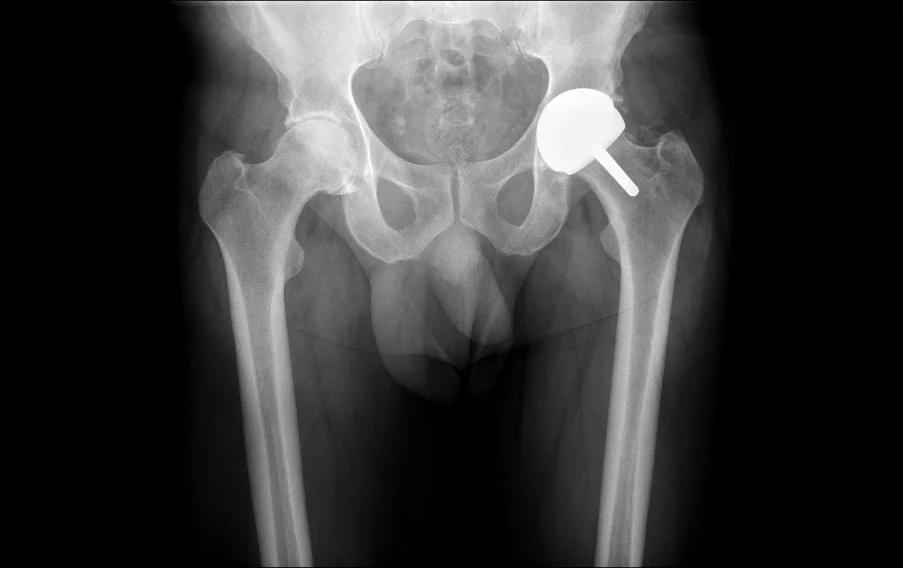
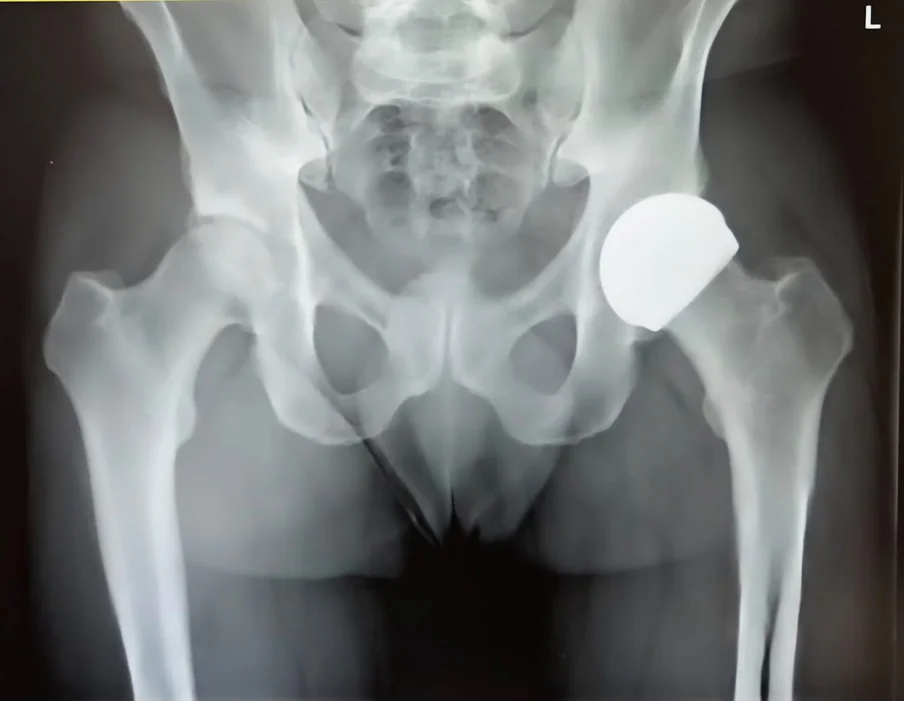
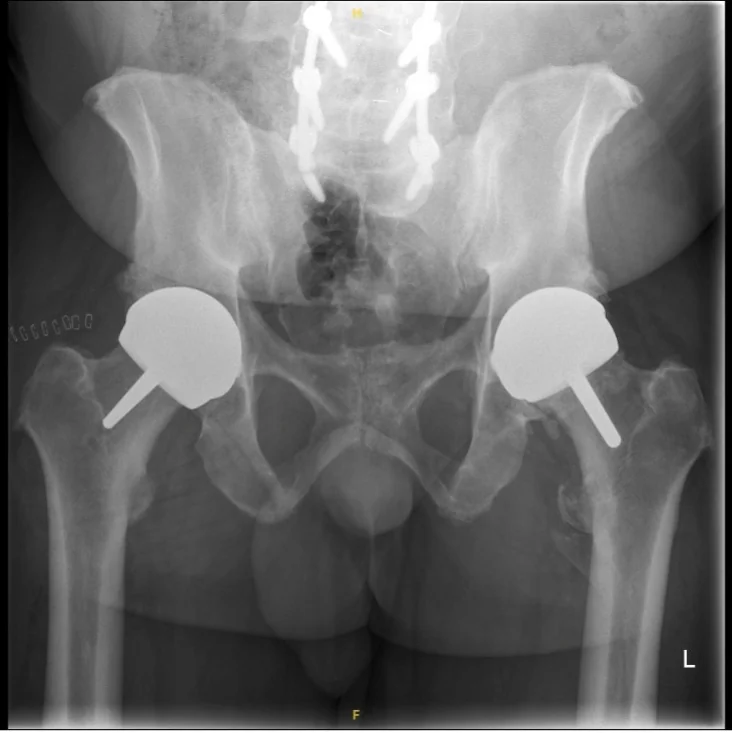
Surgical Images & X-rays
Who is Suitable for Hip Resurfacing?
Hip resurfacing is best suited for active patients with hip arthritis who wish to preserve their natural bone and return to demanding physical activities. Mr Hussain will assess your suitability based on your imaging, bone quality, femoral head size, and activity goals during your consultation. Self-pay and insured patients can review our guide to hip resurfacing cost in Birmingham. For a deeper look at how candidacy is assessed, see am I a candidate for hip resurfacing? and, for female patients, hip resurfacing for women.
Ideal candidates typically include:
Day-Case Hip Resurfacing
Mr Hussain was the first surgeon at the Royal Orthopaedic Hospital to perform day-case hip and knee arthroplasty. For suitable patients, hip resurfacing can be performed as a day-case procedure, meaning you go home the same day as your surgery.
Suitability for day-case discharge depends on the timing of your surgery, your overall medical fitness, and the distance between your home and the hospital. Mr Hussain will discuss this option with you during your consultation.
Recovery Timeline
Every patient is different, but here is a typical recovery journey following hip resurfacing surgery.
For a milestone-by-milestone guide from the day of surgery to full sport clearance, see hip resurfacing recovery, week by week.
Hip Resurfacing Cost in Birmingham
Hip resurfacing with Mr Hussain is an all-inclusive fixed package: £12,250 with the Adept metal-on-metal implant, or £13,450 with a ceramic-on-ceramic implant (ReCerf or H1). The package covers the surgeon's fee, the anaesthetist, your choice of resurfacing implant, your hospital stay, pre-operative assessment, physiotherapy, and follow-up.
Treatment is covered by all major private medical insurers: Bupa, AXA, Vitality, WPA, and Aviva. Wendy, Mr Hussain's secretary, can guide you through authorisation. Full details are on the fees and pricing page, and the dedicated resurfacing site has a step-by-step insurance preauthorisation guide.
What Patients Say
"As a highly experienced orthopaedic consultant myself, I can confidently reassure anyone under his care. He performed a hip resurfacing on me four months ago and I was back operating on my own patients. He has a lovely demeanour and instils confidence with those he consults with. A treasure to his hospital."
Patient Stories
Every patient's journey is different. These are real accounts from people who chose hip resurfacing with Mr Hussain, in their own words.
Hip Resurfacing at a Glance
- Hip resurfacing preserves the femoral head: the ball of the hip is reshaped and capped rather than removed, keeping your natural bone stock for the future.
- The large ball size closely matches your natural anatomy, giving a lower dislocation risk and a hip that feels closer to the original joint.
- Mr Hussain offers three implant systems: Adept (metal-on-metal, primarily for active men with adequate head size) and the ceramic ReCerf and H1, which have reopened resurfacing to women and to patients with metal sensitivity.
- For suitable patients the operation can be done as a day-case; Mr Hussain was the first surgeon at the Royal Orthopaedic Hospital to perform day-case arthroplasty.
- Most patients are off crutches by six weeks, back to low-impact sport by three months, and back to high-impact sport by around six months.
- Fixed self-pay packages: £12,250 with the Adept implant, £13,450 with a ceramic implant; all major private medical insurers are accepted.
Hip Resurfacing FAQs
Read more: Returning to sport after hip resurfacing →
References and further reading
- NHS. Hip replacement. nhs.uk/conditions/hip-replacement
- National Joint Registry (NJR). Annual reports and implant performance data. njrcentre.org.uk
- National Institute for Health and Care Excellence (NICE). Joint replacement (primary): hip, knee and shoulder, NG157. nice.org.uk/guidance/ng157
- MHRA. All metal-on-metal (MoM) hip replacements: updated advice for follow-up of patients, MDA/2017/018. gov.uk
Medically reviewed by Mr Shakir Hussain, Consultant Orthopaedic Surgeon. Last reviewed: June 2026. Next review due: June 2029.
Considering Hip Resurfacing?
Book a specialist consultation with Mr Hussain to discuss whether hip resurfacing is the right option for you.