Why This Question Matters
For active patients in their forties, fifties and sixties, "Will I be able to ski again?" or "Can I get back on the rock?" is rarely an idle question. It is often the question. Hip arthritis ends sporting careers as well as comfortable walks — and for many patients, the prospect of giving up sport altogether is harder to accept than the surgery itself.
Hip resurfacing was developed precisely for this group of patients. The procedure preserves the femoral head and neck, uses a large-diameter ball that closely matches native hip anatomy, and produces a hip that feels and moves much more like the original than a conventional total hip replacement. The biomechanical case for resurfacing in athletic patients has been clear for two decades. The clinical evidence has now caught up.
- Over 90% of patients return to sport after hip resurfacing — the largest pooled meta-analysis to date reports a return-to-sport rate of 90.9%.1
- 80% of patients are back in sport between six and twelve months after surgery, with most low-impact activities resumed sooner.1
- Patients undergoing hip resurfacing achieve higher post-operative activity scores than matched patients undergoing total hip replacement.2,3
Why Hip Resurfacing Suits Athletic Patients
Three biomechanical features make hip resurfacing distinctive for sport:
Bone preservation
In total hip replacement, the entire femoral head and neck are removed. In hip resurfacing, only the worn surface of the head is capped. The natural femoral neck and the bone-implant interface inside the femur are largely preserved. For an athlete, this means a more anatomic restoration of leg length, offset, and the geometry that determines how forces transmit through the hip during running, jumping, and landing.
Large-diameter head
A resurfaced femoral head is typically 38–58 mm in diameter — close to the size of the patient's native hip ball. Conventional total hip replacements use much smaller heads, typically 28–36 mm. The larger head is more stable, has a far lower dislocation rate, and tolerates the extreme ranges of motion required by activities such as climbing, yoga, and martial arts.
Preserved proprioception and gait
Because the femoral neck and much of the head are retained, patients consistently describe a resurfaced hip as feeling more like their natural hip. Gait analysis studies confirm this, showing more normal kinematics after resurfacing than after total hip replacement.4 For sport — where balance, coordination, and rapid changes of direction matter — this is not a small thing.
The published consequence of these design features is what one would expect. In a head-to-head case-control study from the Hospital for Special Surgery in New York, men matched for age, BMI and pre-operative activity scored significantly higher on the High Activity Arthroplasty Score, the Lower Extremity Activity Scale, and the Hip Cycle and Impact scores after resurfacing than after total hip replacement.2 A separate study in patients aged 35 or under found no resurfacings revised at five years, compared with a 9% revision rate in matched total hip replacements — driven mostly by instability and bearing complications that resurfacing does not produce.3
A Realistic Recovery Timeline
Recovery is not a race, but most patients want a clear sense of what is realistic at each stage. The following is the framework Mr Hussain uses with his own patients — adjusted, of course, to the individual.
Weeks 0–6: Healing and walking
The wound heals, swelling settles, and walking distance gradually increases. By six weeks most patients are walking without crutches, driving short distances, and back at desk-based work. Sport is off the table. The job here is to protect the surgical site, follow the physiotherapy plan, and avoid the temptation to do too much too soon.
Six weeks to three months: Reintroducing low-impact activity
Stationary cycling can usually start at around six weeks, swimming once the wound is fully healed (typically four to six weeks), and outdoor cycling on flat ground from around eight to ten weeks. Long walks and gentle hiking are reasonable. Golf is often resumed in this period. The hip is feeling stronger but is not yet ready for impact.
Three to six months: Building load tolerance
This is the window where most patients begin to feel the hip behaving more like their old one. Hill walking, longer cycling rides, doubles tennis, and gentle ski tours on groomed pistes become realistic. Mr Hussain typically allows running on soft surfaces in this window for selected patients, beginning with run-walk intervals.
Six to twelve months: Return to most sports
Most patients are back to their chosen sport in this window. The 2023 meta-analysis by Magan and colleagues — the most comprehensive review of return-to-sport timing after hip resurfacing — confirmed that over 80% of patients had returned to sport by 6–12 months, and 90.9% by final follow-up.1 Skiing, racquet sports, climbing, and longer-distance cycling are usually possible by the end of this period.
Beyond twelve months: Long-term activity
By a year, the hip is essentially as good as it is going to get. Patients can expect that gain to be durable: long-term studies of the Birmingham Hip Resurfacing show implant survival rates over 90% at ten years, with comparable durability in the cohorts where high-impact sport was actively pursued.5
Sport by Sport
The table below summarises a realistic timeline and the key consideration for each major sport. As always, this is general guidance — individual recovery varies, and the advice in your own consultation will be tailored to you.
| Sport | Earliest realistic return | Impact level | Key consideration |
|---|---|---|---|
| Swimming | 4–6 weeks | Low | Wound must be fully healed before pool entry. Avoid breaststroke kick for the first three months — the rotational stress is unhelpful early on. |
| Cycling (stationary) | 6 weeks | Low | An excellent rehabilitation tool. Keep resistance light initially and saddle height generous to limit hip flexion. |
| Cycling (outdoor) | 8–10 weeks | Low | Avoid clipless pedals and challenging terrain initially — the risk is the fall, not the cycling itself. |
| Walking and hiking | From day one (progressively) | Low | Build distance gradually. Hill walking with poles becomes comfortable from around three months. |
| Golf | 8–12 weeks | Low | Start with putting and chipping at six weeks; full swing from around three months. Most patients return without any change to their handicap. |
| Yoga and Pilates | 8–12 weeks | Low | A good fit for resurfacing patients. The large head tolerates extreme ranges of motion that would risk dislocation in a small-head total hip replacement. |
| Skiing (groomed pistes) | 5–6 months | Moderate | Realistic for the next ski season after summer surgery. Begin on intermediate runs; build up gradually. Wear a helmet — the risk on the slopes is a fall, not the resurfacing. |
| Tennis (doubles) | 4–6 months | Moderate | Doubles is gentler on the hip than singles because of the smaller court coverage. Most patients return to their previous standard. |
| Running | 6–12 months | High | A systematic review reported 69% of resurfacing patients returned to running, with several maintaining marathon and Ironman participation.6 Begin with run-walk intervals on softer surfaces. Limit weekly mileage rather than chase personal bests. |
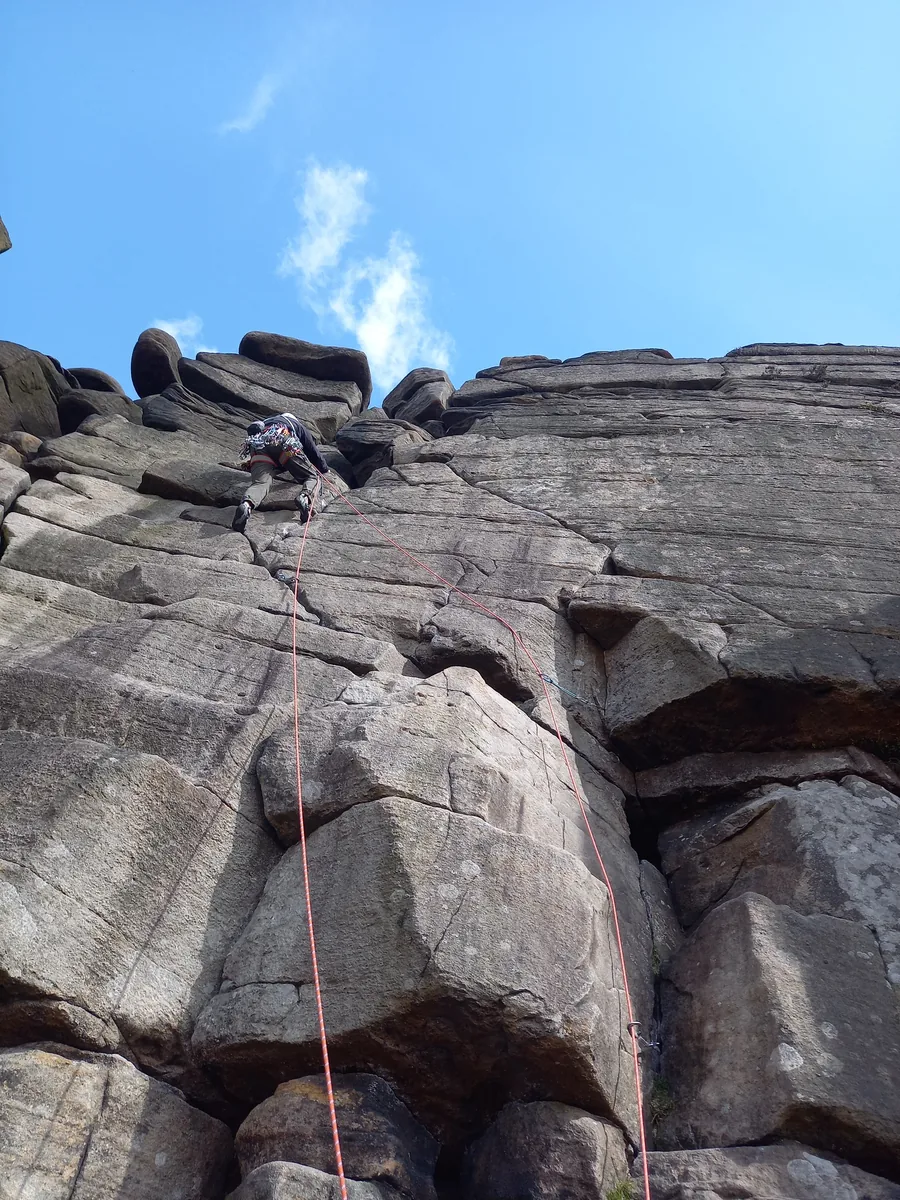
| Rock climbing | 6 months | Moderate | Top-rope and trad climbing on grit or sport routes are realistic for many of Mr Hussain's patients. The large head tolerates the deep flexion and rotation climbing demands. Avoid bouldering with high jump-offs in the first year. |
| Squash and singles tennis | 9–12 months | High | Repetitive twisting and impact loading. Achievable for many patients but requires a careful build-up. |
| Contact and team sports | Case-by-case | High | Rugby, football and martial arts involve unpredictable collisions. Mr Hussain rarely advises full return to contact sport — the consequences of a serious fall outweigh the benefit. A frank conversation in clinic is the right way to make this decision. |
What the Evidence Actually Shows
The literature on return to sport after hip resurfacing has grown considerably over the last fifteen years. Three studies are particularly worth knowing about:
The 2023 meta-analysis (Magan and colleagues)
This is the most comprehensive review to date. The authors pooled data from eleven studies including 659 patients undergoing hip resurfacing arthroplasty. They reported a return-to-sport rate of 90.9% by final follow-up (mean three years), with over 80% of patients back in sport between six and twelve months after surgery. The authors concluded that "the findings of this meta-analysis will enable more informed discussions between patients and healthcare professionals about time for return to sports following hip resurfacing arthroplasty."1
The Hospital for Special Surgery case-control study (Rueckl and colleagues, 2020)
Forty patients with hip resurfacing were matched with forty patients with total hip replacement on age, BMI, and pre-operative activity. At a mean follow-up of nearly five years, the resurfacing patients scored significantly higher on every activity-related outcome measure: the High Activity Arthroplasty Score, the Lower Extremity Activity Scale, the Hip Cycle Score, and the Impact Score. The authors concluded that "young male patients are able to engage in higher activity levels after hip resurfacing compared to standard total hip arthroplasty."2
The high-impact sport prospective study (Le Duff and colleagues)
A single-surgeon prospective series of 215 hip resurfacings examined whether high-impact sport was actually safe in this population. At a mean of nearly four years, patients had successfully resumed high-impact activities. The authors noted that "the rate of return to sports after resurfacing arthroplasty appears to be excellent and unequalled by conventional hip prostheses."7
The Honest Caveats
It would be dishonest to suggest that hip resurfacing turns every patient into a competitive athlete. Realistic counselling has three components:
- Recovery is variable. Most patients return to their previous level of sport. A minority do not — usually because of unrelated factors such as stiffness, weakness from years of arthritis, or simple deconditioning that takes longer to reverse than the surgery itself takes to heal.
- Higher activity levels do increase wear. Long-term studies show modestly higher revision rates in the highest-impact-activity groups compared with lower-activity patients.5,7 The numbers are still small, but they are not zero. The trade-off is part of the conversation.
- Listen to the hip. Pain that comes on with activity and settles with rest is the hip telling you to ease back. Pain that persists, or that wakes you at night, is a different matter and should be reviewed.
Generally, patients who return to sport after hip resurfacing tell Mr Hussain a similar story: the hip becomes a part of life that no longer needs to be thought about. That is the goal: not to eliminate every restriction, but to give the hip back enough that the rest of life can be lived around it. Many of Mr Hussain's patients have described that journey in their own words; you can read their hip resurfacing patient stories and reviews on his dedicated hip resurfacing site.
Speak to Mr Hussain About Your Sport
Every active patient brings their own history, expectations, and ambitions to the consultation. The right operation, the right implant, and the right rehabilitation plan all depend on the answers to a small number of practical questions: which sport, what level, how often, and what does success look like for you? If hip arthritis is interfering with your active life, those are the questions worth bringing to your appointment. For a sense of what other active patients have achieved, from skiing to marathon running, visit the patient stories and verified reviews from hip resurfacing patients.
References
- Magan A, Wignadasan W, Kayani B, Radhakrishnan G, Ronca F, Haddad FS. A meta-analysis assessing time for return to sport following hip resurfacing. Arch Orthop Trauma Surg. 2023;143(6):3575–3585.
- Rueckl K, Liebich A, Bechler U, Springer B, Rudert M, Boettner F. Return to sports after hip resurfacing versus total hip arthroplasty: a mid-term case control study. Arch Orthop Trauma Surg. 2020;140(7):957–962.
- LeBrun DG, Shen TS, Bovonratwet P, Morgenstern R, Su EP. Hip Resurfacing vs Total Hip Arthroplasty in Patients Younger than 35 Years. Arthroplasty Today. 2021;11:229–233.
- Szymanski C, Thouvarecq R, Dujardin F, et al. Functional performance after hip resurfacing or total hip replacement: a comparative assessment with non-operated subjects. Orthop Traumatol Surg Res. 2012;98(1):1–7.
- Murray DW, Grammatopoulos G, Pandit H, Gundle R, Gill HS, McLardy-Smith P. The ten-year survival of the Birmingham hip resurfacing: an independent series. J Bone Joint Surg Br. 2012;94(9):1180–1186.
- Panarello NM, Tracey RW, et al. Running Following Hip Arthroplasty: A Systematic Review. J Arthroplasty. Reviewing publications 2000–2020.
- Le Duff MJ, Amstutz HC, et al. Can patients return to high-impact physical activities after hip resurfacing? A prospective study. Int Orthop. 2013;37(7):1233–1240.
Frequently Asked Questions
Can I run a marathon after hip resurfacing?
It is possible, and several patients in published series have done so. The systematic review of running after hip arthroplasty found that 69% of resurfacing patients returned to running, with some maintaining marathon and Ironman distances.6 The honest answer is that long-distance running is achievable but not effortless: it requires a careful return-to-running protocol, attention to mileage, and an honest conversation about whether the goal is worth the additional wear it places on the implant.
How soon can I ski after hip resurfacing?
Most patients are skiing groomed pistes by five to six months after surgery — meaning a summer hip resurfacing usually allows a return for the next ski season. Off-piste and competitive skiing typically wait until nine to twelve months. The risk on the slopes is the fall, not the skiing itself; helmet use is sensible for everyone.
Is rock climbing safe after hip resurfacing?
For most patients, yes. The large femoral head used in resurfacing tolerates the deep flexion and rotation climbing demands far better than a conventional total hip replacement. Top-rope, sport, and gentler trad climbing are realistic from around six months. Bouldering with significant jump-offs is best avoided in the first year.
Are the restrictions different from a total hip replacement?
Yes. Patients with conventional total hip replacements are routinely advised to avoid extreme flexion, deep squats, and certain rotations because of the dislocation risk associated with smaller bearing diameters. The large-diameter head used in hip resurfacing essentially removes that concern, which is why activities such as yoga, climbing and martial arts are far more permissible after resurfacing than after total hip replacement.
What is the long-term evidence for an active lifestyle after hip resurfacing?
The Birmingham Hip Resurfacing has now been studied in independent ten-year series and shows survival rates above 90% in well-selected patients.5 High-impact-activity cohorts have been followed prospectively for several years without alarming wear or revision rates. The combination of bone preservation and a large-head bearing is what makes a return to sport realistic and durable.