Total Hip Replacement Surgery

Expert hip replacement surgery by one of the UK's highest-volume lower limb arthroplasty surgeons. Offering conventional and day-case total hip replacement with outstanding patient outcomes at specialist hospitals in Birmingham.

Understanding the Procedure

What Is Hip Replacement Surgery?

Hip replacement surgery — also known as total hip arthroplasty — involves replacing the damaged or worn-out hip joint with an artificial implant. The procedure removes the arthritic ball (femoral head) and damaged socket (acetabulum), replacing them with precision-engineered components made from advanced materials such as ceramic, metal, and highly cross-linked polyethylene.

The goal is to relieve pain, restore mobility, and return you to the activities you enjoy. Modern hip replacements are designed to last 25 years or more, and advances in implant design and surgical technique have made this one of the most successful operations in modern medicine.

Mr Hussain performs hip replacement surgery using the latest evidence-based techniques, tailored to your individual anatomy and lifestyle goals.

The Hip Joint
  • Femoral head — the ball at the top of the thighbone
  • Acetabulum — the socket in the pelvis
  • Articular cartilage — smooth coating that allows pain-free movement
  • Synovial membrane — produces lubricating fluid
  • Labrum — ring of cartilage around the socket rim

When arthritis damages these structures, hip replacement restores the joint with artificial components designed to replicate natural movement.

Is It Right for You?

When to Consider Hip Replacement

Hip replacement is typically recommended when non-surgical treatments are no longer managing your symptoms effectively. You may be a candidate if you experience:

🔴

Persistent Hip Pain

Pain that limits your daily activities, disturbs your sleep, or is no longer controlled by painkillers and anti-inflammatory medication.

🚶

Reduced Mobility

Difficulty walking, climbing stairs, getting in and out of a car, or putting on shoes and socks due to stiffness and pain in the hip.

💊

Failed Conservative Treatment

Physiotherapy, weight management, injections, and medication have been tried but are no longer providing adequate relief.

🩻

X-ray Evidence of Arthritis

Imaging shows significant joint damage — loss of cartilage, bone-on-bone contact, or other structural changes in the hip.

😔

Impact on Quality of Life

Your hip condition is stopping you from enjoying hobbies, exercising, working, or spending time with family and friends.

🔄

Other Hip Conditions

Avascular necrosis, hip fracture, developmental dysplasia, or inflammatory arthritis that has significantly damaged the joint.

Surgical Options

Types of Hip Replacement

Mr Hussain offers the full range of hip replacement options, selecting the most appropriate approach based on your age, activity level, bone quality, and anatomy.

Most Common

Total Hip Replacement

The entire hip joint is replaced — both the ball and socket. This is the gold standard for treating severe arthritis and is the most commonly performed type of hip replacement.

  • Suitable for most patients with hip arthritis
  • Excellent pain relief and function restoration
  • Modern implants designed to last 25+ years
  • Available as day-case or overnight stay
Minimally Invasive

Surgical Approach

Mr Hussain uses muscle-sparing surgical approaches that minimise tissue disruption, leading to less pain, reduced blood loss, and a faster recovery compared to traditional techniques.

  • Posterior approach preserving key hip muscles
  • Smaller incision with less soft tissue damage
  • Reduced post-operative pain and bruising
  • Earlier mobilisation and shorter hospital stay
Cemented & Cementless

Fixation Options

The implant can be fixed to the bone using bone cement (cemented) or designed to allow bone to grow into the implant surface (cementless). The choice depends on your bone quality and age.

  • Cemented — excellent for older patients or poorer bone quality
  • Cementless — ideal for younger, more active patients
  • Hybrid options combining both approaches
  • Decision made based on individual assessment
Same-Day Discharge

Day-Case Hip Replacement

For suitable patients, Mr Hussain offers day-case total hip replacement — allowing you to return home the same day as your surgery. He was the first surgeon at the ROH to introduce day-case hip and knee replacement.

  • Recover in the comfort of your own home
  • Careful patient selection for safety
  • Enhanced recovery protocols
  • Ongoing physiotherapy support post-discharge
Specialist Expertise

Complex Hip Replacement

Mr Hussain has extensive experience managing complex primary hip replacements — cases that go beyond routine surgery due to unusual anatomy, developmental conditions, previous trauma, or metabolic bone disease.

  • Hip dysplasia and abnormal socket development
  • Avascular necrosis and bone collapse
  • Previous fracture malunion altering anatomy
  • Custom implants for unusual anatomy
  • Multidisciplinary team approach with HDU support
Specialist Expertise

Complex Hip Replacement Surgery

Not every hip replacement is straightforward. Mr Hussain's advanced fellowship training and high-volume practice mean he is equipped to manage even the most challenging cases.

Complex hip replacement surgery is required when the standard approach is not sufficient — for example, when there is significant bone loss, abnormal anatomy, previous trauma, or developmental conditions that have altered the shape of the hip joint. These cases demand a higher level of surgical expertise, advanced implant options, and careful pre-operative planning.

Mr Hussain regularly manages complex primary hip replacements in patients with unusual anatomy due to conditions such as hip dysplasia, avascular necrosis, previous fracture malunion, or Paget's disease. His experience with custom implants, acetabular reconstruction, and specialised fixation techniques — combined with access to the Royal Orthopaedic Hospital's specialist facilities — ensures the best possible outcomes for patients facing these challenging situations.

  • Hip dysplasia — abnormal socket development requiring specialised reconstruction
  • Avascular necrosis — loss of blood supply causing bone collapse
  • Previous hip fracture or malunion altering normal anatomy
  • Severe protrusio — socket pushed inward requiring bone grafting
  • Paget's disease and other metabolic bone conditions
  • Custom implants designed to match individual patient anatomy
🏥

Specialist Tertiary Centre

The Royal Orthopaedic Hospital is one of the UK's largest specialist orthopaedic hospitals, with the facilities and support team to manage the most complex cases.

👥

Multidisciplinary Approach

Complex cases are discussed in MDT meetings bringing together orthopaedic, anaesthetic, medical, and specialist nursing expertise to plan the safest approach.

🛡️

High-Dependency Care

Both the Harborne Hospital and Priory Hospital Edgbaston have HDU facilities available for complex cases requiring closer post-operative monitoring.

🦴

Advanced Implant Options

Access to the full range of implant solutions including custom-made prostheses, augments, and specialised fixation for the most anatomically challenging cases.

What Patients Say

Verified Patient Reviews

4.99
★★★★★
468 verified reviews on Doctify
Read All 468 Reviews on Doctify →
Your Experience

Your Hip Replacement Journey

From your first consultation through to full recovery, Mr Hussain and his team provide expert care at every stage.

Consultation

Thorough assessment of your hip, review of X-rays and scans, discussion of all treatment options, and a personalised surgical plan.

Pre-Assessment

Medical checks, blood tests, and any additional imaging to ensure you are fit and ready for surgery.

Surgery Day

Admitted on the day of surgery. The procedure typically takes 60–90 minutes. Most patients are up and walking within hours.

Hospital Stay

Typically 1–2 nights, or same-day discharge for day-case patients. Physiotherapy begins immediately to get you moving safely.

Recovery

Wound check at 2 weeks. Most patients are driving at 6 weeks and back to full activities by 3–6 months, with ongoing follow-up.

Getting Back to Life

Recovery After Hip Replacement

Recovery varies for each patient, but most people experience significant pain relief within the first few weeks. Here's a general guide to what you can expect:

Day 1

Standing & Walking

Most patients are up and walking with support within hours of surgery. Physiotherapy begins immediately.

2 Weeks

Wound Healed

Wound check and removal of any clips or stitches. Light activities around the home. Gradually increasing mobility.

6 Weeks

Driving & Independence

Most patients are driving and managing daily activities independently. Continued physiotherapy exercises.

3–6 Months

Full Recovery

Return to most activities including walking, swimming, cycling, and golf. Full rehabilitation and follow-up review.

Patient Story

Walking Again and Living Again — Doreen's Story

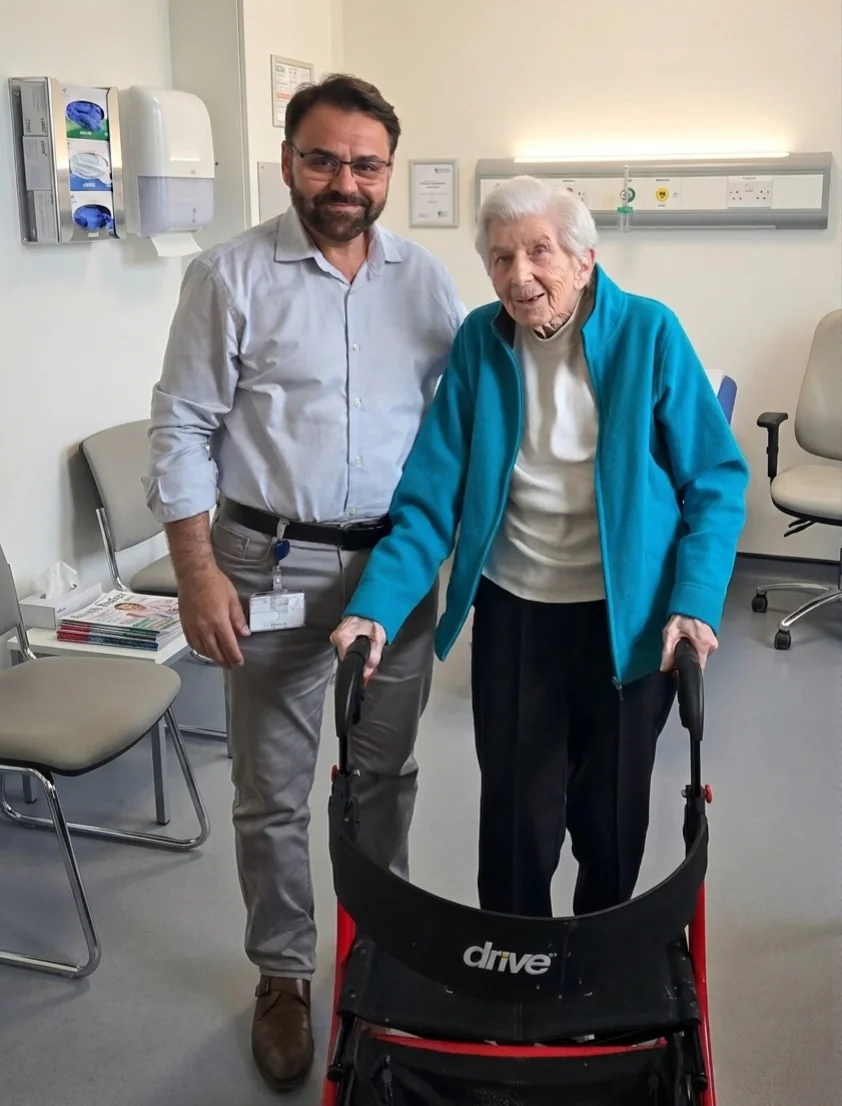
Mr Shakir Hussain with Doreen, aged 97, after her successful total hip replacement at the Royal Orthopaedic Hospital

"The transformation in my life is amazing"

Mr Hussain came to see me and said, 'Doreen, you will walk again'. What better news could anyone have? The transformation in my life is amazing since my total hip replacement at the Woodlands Suite. I am living back at home and can now walk around my bungalow. My life is worth living now.

Total Hip Replacement at the Woodlands Suite, Royal Orthopaedic Hospital

Just months before surgery, Doreen was living in near-constant pain, unable to walk and confined to a care home. After her total hip replacement by Mr Hussain, she returned home and regained her independence — making her own tea, preparing lunch, and moving freely around her bungalow.

Her daughter Lesley adds: "My mum now needs far less support than before her surgery and is able to do things we never thought possible just months ago."

Read Doreen's Full Story →
Common Questions

Frequently Asked Questions

How long does hip replacement surgery take?+
The operation typically takes between 60 and 90 minutes. You will be in the operating theatre for a little longer than this to allow for anaesthesia and preparation. Most patients are awake and comfortable in the recovery area within two hours of arriving in theatre.
How long will I stay in hospital?+
Most patients stay for 1–2 nights following a total hip replacement. For suitable patients, Mr Hussain offers day-case hip replacement — meaning you can go home the same day. Your length of stay will depend on your individual recovery, medical fitness, and home support.
What type of anaesthetic is used?+
Hip replacement is most commonly performed under spinal anaesthesia, which numbs you from the waist down while you remain awake but relaxed. You may also have sedation to keep you comfortable. General anaesthesia is available if preferred. The anaesthetist will discuss the best option for you at your pre-assessment appointment.
When can I drive after hip replacement?+
Most patients can return to driving at around 6 weeks after surgery, once you are comfortable and confident performing an emergency stop. This will be discussed at your follow-up appointment. If your left hip was replaced and you drive an automatic, you may be able to drive sooner.
How long does a hip replacement last?+
Modern hip replacements are designed to last 25 years or more. National Joint Registry data shows that over 95% of hip replacements are still functioning well at 15 years. Mr Hussain uses implants with excellent long-term track records in national and international registries.
What implants does Mr Hussain use?+
Mr Hussain uses implants with excellent long-term track records in national and international joint registries. The choice of implant — including whether cemented or cementless fixation is used — is tailored to your individual needs based on your age, bone quality, activity level, and anatomy. This will be discussed in detail during your consultation.
What are the risks of hip replacement surgery?+
Hip replacement is one of the most successful operations in medicine, but like all surgery, it carries some risks. These include infection, blood clots, dislocation, nerve or blood vessel injury, leg length difference, and the need for further surgery in the future. Mr Hussain will discuss these risks with you in detail during your consultation, and takes every precaution to minimise them.
Can I have a hip replacement if I have complex medical needs?+
Yes. Patients with complex medical conditions can still undergo hip replacement surgery safely, provided there is careful pre-operative assessment and optimisation. This may involve input from other specialists — such as cardiologists, respiratory physicians, or endocrinologists — to ensure you are in the best possible condition for surgery. For patients who require closer monitoring after their operation, high-dependency care (HDU) is available at both the Harborne Hospital and Priory Hospital Edgbaston. Mr Hussain will discuss your individual needs in detail during your consultation.
Is hip replacement covered by insurance?+
Yes, hip replacement is covered by most private medical insurance policies. Mr Hussain is recognised by all major insurers including Bupa, Aviva, AXA PPP, Vitality, Cigna, and many more. Self-pay options with transparent pricing are also available. Contact Wendy Richards, Mr Hussain's secretary, for guidance on insurance authorisation.

Ready to Discuss Your Hip Replacement?

Take the first step towards a pain-free, active life. Book a consultation with Mr Hussain to discuss your options.